

Rain Cyber
SUPERADMIN
Sep 7, 2026
In today’s digital-first world, mobile applications have become an essential part of how businesses connect with customers, manage operations, and deliver services. Among mobile platforms, Android continues to be one of the most widely used ecosystems worldwide, making Android app development a valuable investment for businesses of all sizes.
Whether you are launching a startup, expanding an existing business, or transforming an offline service into a digital platform, a well-designed Android application can help you reach your audience and create a more convenient customer experience.
What Is Android App Development?
Android app development is the process of designing, developing, testing, and maintaining applications that run on Android smartphones, tablets, TVs, and other compatible devices.
A successful Android application involves much more than writing code. It combines:
UI/UX design
Front-end development
Backend and API integration
Database management
Security implementation
Performance optimization
Quality assurance and testing
Deployment and ongoing maintenance
The goal is to create an application that is reliable, secure, easy to use, and capable of meeting specific business and customer requirements.
Why Should Your Business Invest in an Android App?
1. Reach a Large Mobile Audience
Android powers a huge variety of smartphones and devices across different markets. Developing an Android application allows businesses to reach customers through a platform they already use every day.
2. Improve Customer Engagement
A mobile app provides a direct communication channel between your business and customers. Features such as push notifications, personalized content, loyalty programs, and in-app messaging can help improve engagement.
3. Provide Better User Experience
Customers increasingly expect fast and convenient digital experiences. A dedicated Android app can make it easier for users to browse products, place orders, make payments, book services, track deliveries, or manage accounts.
4. Streamline Business Operations
Android applications are not limited to customer-facing services. Businesses can use custom apps for inventory management, employee management, sales tracking, field operations, reporting, and internal communication.
5. Build a Strong Digital Presence
A professional mobile application can strengthen your brand identity and make your business more accessible to customers.
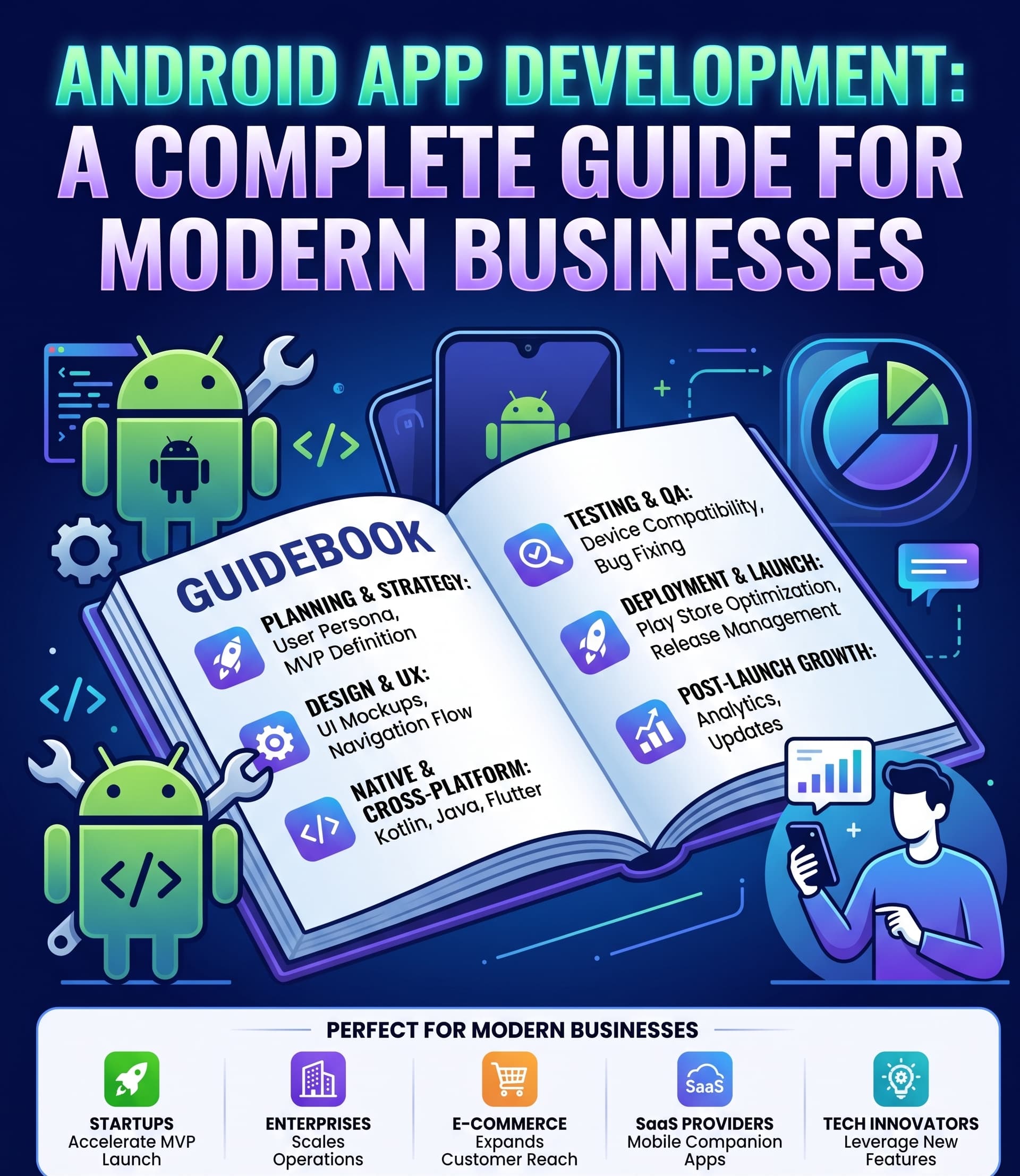
Our Android App Development Process
A structured development process helps ensure that the final application meets both technical and business objectives.
Step 1: Requirement Analysis
We begin by understanding your business goals, target users, required features, competitors, and technical requirements. This helps establish a clear development roadmap.
Step 2: UI/UX Design
The application's interface is designed with usability in mind. We focus on intuitive navigation, clear layouts, responsive screens, and a consistent visual identity.
Step 3: App Development
Developers transform the approved designs into a functional Android application. Depending on the project's requirements, the app can include APIs, databases, payment systems, authentication, cloud services, maps, notifications, and other integrations.
Step 4: Testing & Quality Assurance
Before launch, the application should be thoroughly tested across different devices and screen sizes. Functional, performance, usability, compatibility, and security testing help identify and resolve issues.
Step 5: Deployment
After successful testing, the application is prepared for release through the appropriate distribution channels, including the Google Play Store.
Step 6: Maintenance & Updates
Android applications require ongoing maintenance. Regular updates can improve security, compatibility, performance, and functionality while allowing businesses to introduce new features.
Key Features We Can Build
A custom Android application can be tailored to your specific business requirements. Common features include:
User registration and secure login
Social login
Product and service catalogs
E-commerce functionality
Shopping cart and checkout
Online payment integration
Push notifications
GPS and location services
Real-time tracking
Chat and messaging
Appointment and booking systems
Customer dashboards
Admin panels
Inventory management
Analytics and reporting
API and third-party integrations
Cloud database integration
Multi-language support
Android App Security Matters
Security should be considered from the beginning of the development process. Applications may handle sensitive customer information, payment data, authentication credentials, and business information.
Good development practices can include secure authentication, encrypted communication, appropriate data protection, secure API implementation, input validation, and regular security updates.
Native vs. Cross-Platform Android Development
Businesses generally have several technology approaches available when developing mobile applications.
Native development focuses specifically on Android and can provide excellent platform integration and performance.
Cross-platform development allows applications to share a significant portion of their code across multiple platforms. This can be useful for businesses that want both Android and iOS applications while optimizing development resources.
The best approach depends on factors such as application complexity, performance requirements, budget, timeline, and long-term development plans.
Why Choose Professional Android App Development Services?
Developing an application without proper planning can lead to performance problems, security vulnerabilities, poor user experience, and expensive maintenance.
Working with an experienced development team can help you:
Define the right technology strategy
Create a user-friendly interface
Build scalable application architecture
Integrate APIs and third-party services
Test the application thoroughly
Improve application performance
Prepare the app for deployment
Provide ongoing maintenance and support
Conclusion
Android app development can help businesses turn ideas into powerful digital products. From e-commerce and restaurant applications to enterprise systems, booking platforms, educational apps, and custom business solutions, Android provides a flexible platform for reaching users and improving digital experiences.
The key to a successful application is not simply having many features. It is about building a secure, reliable, scalable, and user-friendly product that solves a real problem for your customers.
If you have an Android app idea, the right development strategy can turn that idea into a practical solution that supports your business growth.